 CuriCart
Curicart · Global Trend Guide
Professional shopping guide | Overseas Taobao forwarding | Exploring brands
✨ Kakobuy · CNFans · ACBuy one-stop price comparison purchase
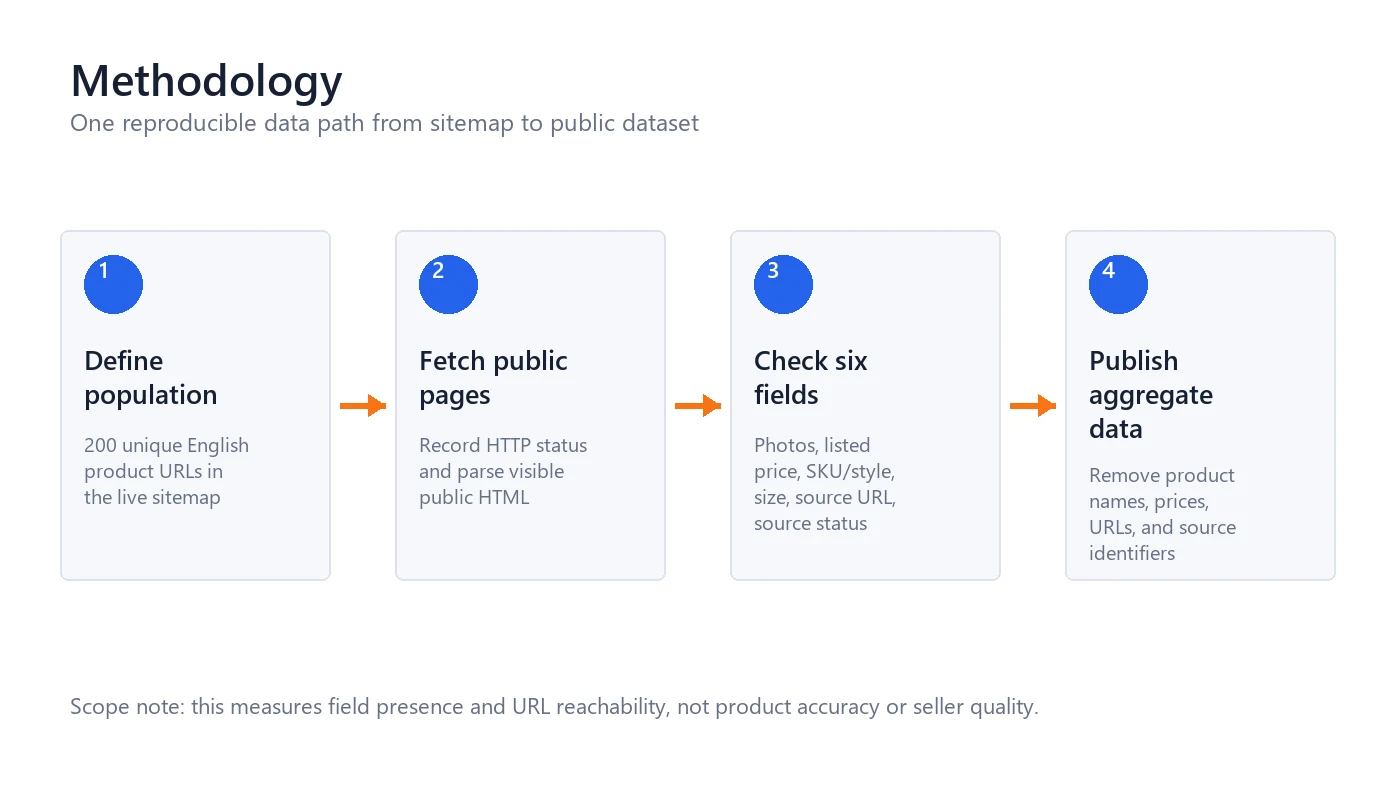
On September 7, 2026, CuriCart audited every English product URL in its live sitemap: 200 pages. All 200 returned HTTP 200 and exposed product photos, a listed price, SKU or style context, and a Weidian source URL. None displayed populated size options. The 14 unique source URLs all returned HTTP 200 during the check. These results measure field presence and reachability, not accuracy, availability, seller quality, or product quality.
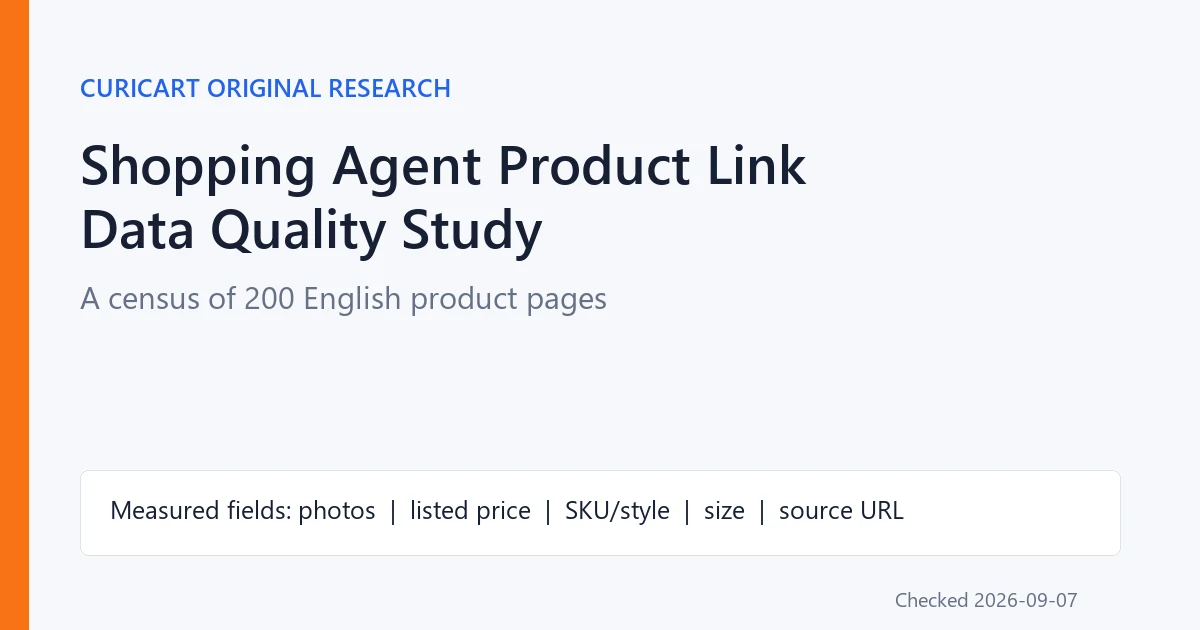
200 of 200 product-page URLs returned HTTP 200. This was a census of the English product URLs listed in the live CuriCart sitemap, not a sample.
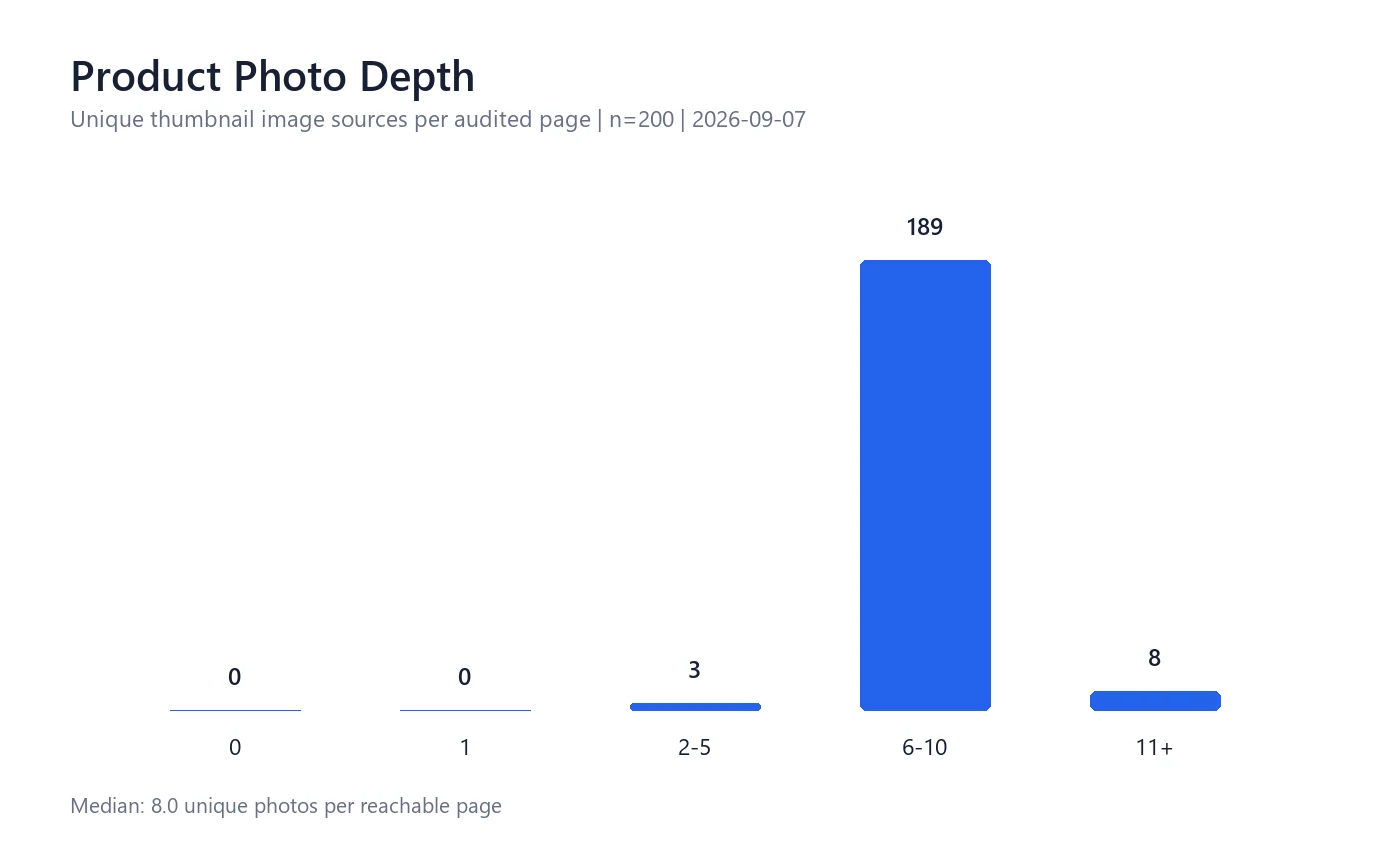
Product photos were present on 200 pages. The median page exposed eight unique thumbnail image sources. The range was four to 12.
A listed price was detected on all 200 pages. The audit recorded presence only. It did not compare the displayed value with a seller page or later transaction value.
SKU or style context was detected on all 200 pages. A visible style label, a style identifier in the page title, or a populated option control met this rule.
Populated size options were detected on zero pages. The current template could contain a size-area container, but an empty container did not count as size information.
A Weidian source URL was detected on all 200 pages. The 200 records resolved to 14 unique source URLs because many page URLs represented style variants connected to the same source.
All 14 unique source URLs returned HTTP 200 during the check. This confirms technical reachability at that moment. It does not confirm current availability, seller identity, listing accuracy, or suitability.
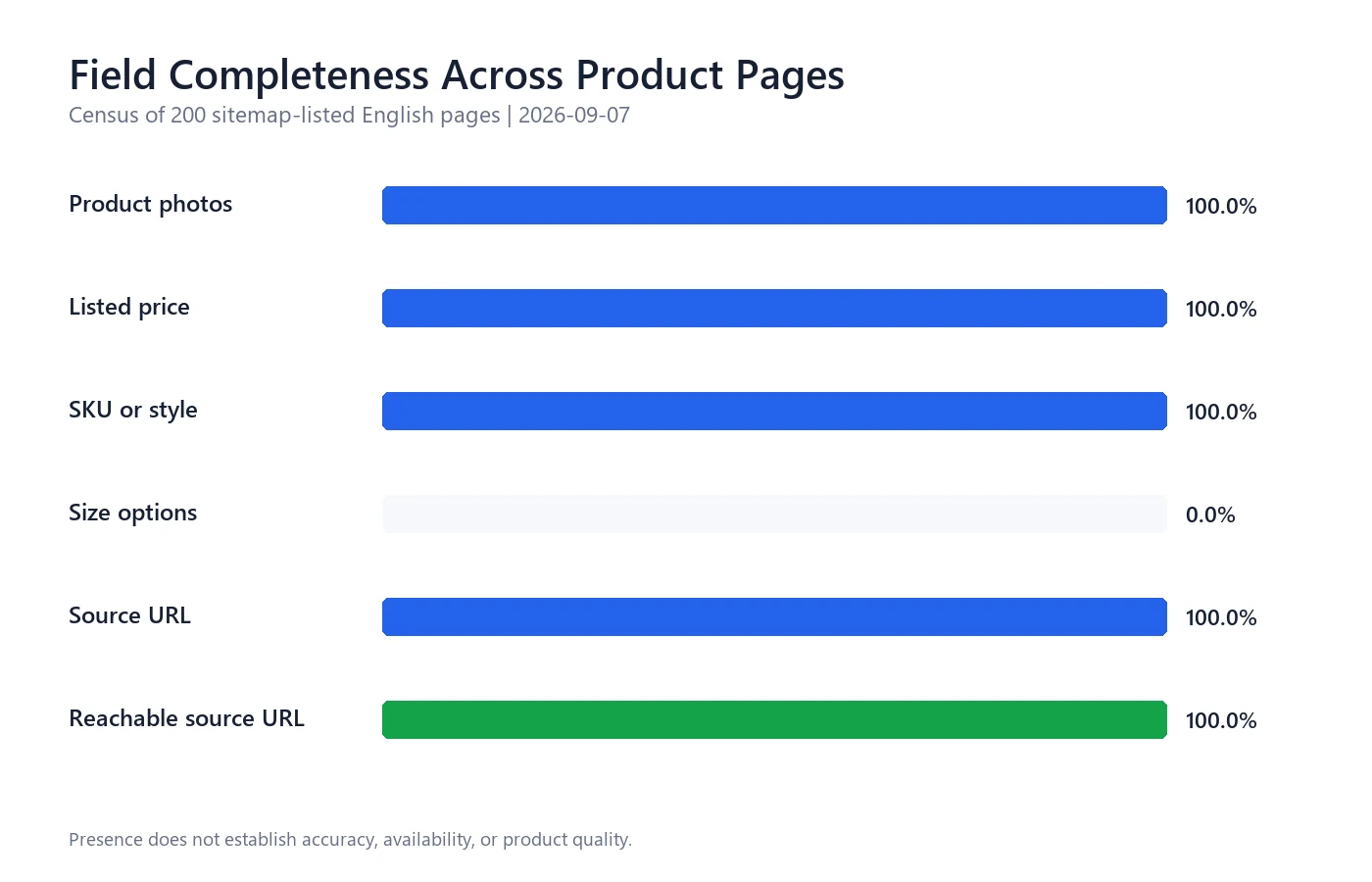
The study began with the live CuriCart XML sitemap. The script selected every unique URL that matched the English productview pattern. The resulting population contained 200 URLs, so a full census was more useful than a sample. No estimate or margin of error was needed for this defined population.
Each product URL was requested from the public web. A temporary connection failure could be retried up to three times. The script then parsed the returned public HTML and applied the same field rules to every page.
| Field | Counted as present when |
|---|---|
| Product photos | At least one unique image source appeared in the product thumbnail area. |
| Listed price | The visible product price area contained a displayed dollar reference. |
| SKU or style | The page exposed a style label, a style identifier, or populated specification controls. |
| Size options | At least one visible size value appeared in a size specification group or size-option area. |
| Source URL | A complete Weidian or Taobao item URL could be extracted from the public page HTML. |
| Reachable source | A request to the normalized source URL returned a 2xx or 3xx HTTP status. |
Source requests were deduplicated before testing. This matters because 200 product-page records shared only 14 unique source URLs. Each unique source was checked once, and the result was then mapped back to every related page record.
The population is precise but narrow: unique English CuriCart productview URLs present in the live sitemap on September 7, 2026. It does not include product pages absent from the sitemap, other language URLs, category pages, shopping-agent guide pages, or external spreadsheets.
The unit of analysis is a product-page URL record. It is not necessarily a unique product, seller, or marketplace listing. The difference is visible in the data: 200 page records mapped to 14 unique Weidian source URLs. Style pages can therefore increase the page count without increasing the number of independent source listings.
| Measured field | Pages with field | Completeness |
|---|---|---|
| Product photos | 200 / 200 | 100.0% |
| Listed price | 200 / 200 | 100.0% |
| SKU or style | 200 / 200 | 100.0% |
| Populated size options | 0 / 200 | 0.0% |
| Weidian source URL | 200 / 200 | 100.0% |
| Source URL returning 2xx/3xx | 200 / 200 | 100.0% |
No page met all five product-information checks because none exposed populated size options. This does not mean the products have no sizes. It means size values were not visible in the public HTML fields measured by this audit.
Photo depth was more consistent. Three pages contained two to five unique thumbnail sources. Another 189 contained six to 10. Eight contained 11 or more. The median was eight, and the mean was 8.3.
Every page exposed a Weidian source URL. After deduplication, the set contained 14 unique URLs. All 14 returned HTTP 200 during the check. A status response is useful for finding broken destinations, but it is only a transport-level signal.
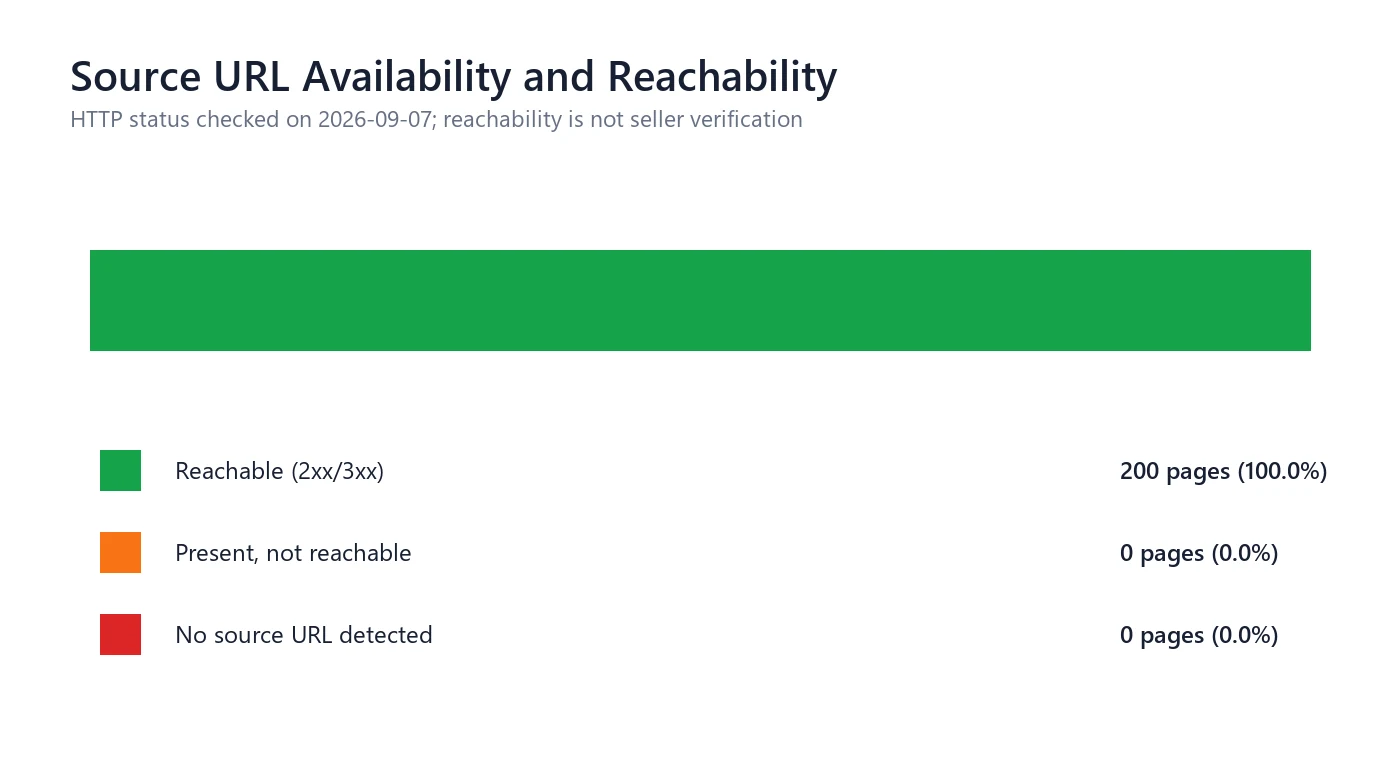
The audited pages were strong at preserving basic research context. A reader could see multiple product images, a listed price reference, style or SKU context, and a source URL on every page in the defined population. The source links were also technically reachable during the test.
The main information gap was size selection. A shopper comparing a page should not infer an available size from the title, the photos, or another style page. A populated size field was absent across the audited population. Size therefore needs a separate current check on the relevant source or platform page.
The source concentration also changes how the numbers should be interpreted. Two hundred complete-looking page records did not represent 200 independent marketplace sources. They represented many style-specific pages connected to a much smaller set of source listings. For research quality, both page-level completeness and source-level diversity matter.
Confirm that the destination page loads.
Count whether the page offers enough distinct product views for visual comparison.
Treat the displayed price as a reference, not a final value.
Record the exact SKU or style shown.
Mark size as unknown when no populated size field is visible.
Open the source URL and confirm its current page separately.
Readers who need more context can use the Shopping Agent Platform Guide, browse CuriCart Buy Research Guides, or read how to inspect a Weidian product link.
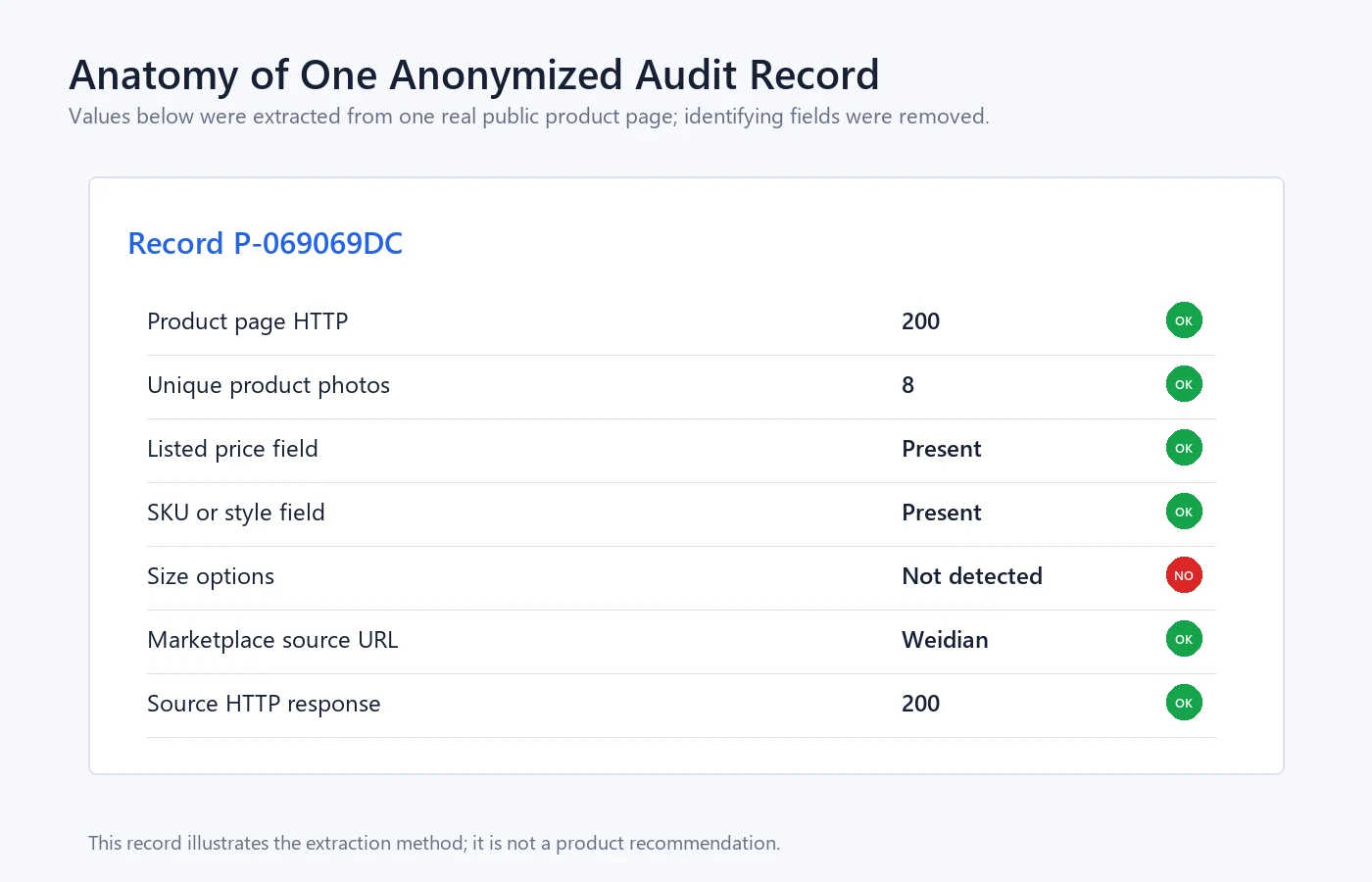
This study measures whether defined fields appeared in public HTML on one date. It does not score the accuracy of those fields. It does not compare page data with an order, a delivered item, or an external seller record.
The product images were counted as product photos. The audit did not classify them as agent-issued QC photos. A photo count also cannot prove that the images show every relevant angle or the exact selected option.
The price check recorded whether a listed price appeared. It did not test currency conversion, discounts, fees, or a final amount. The source-link check recorded an HTTP response. It did not establish current availability, seller reliability, platform acceptance, product condition, or authenticity.
The sitemap is a changing population frame. New pages can enter it, old pages can leave it, and fields can change after this study date. A future rerun should be reported as a new dated result rather than silently replacing this dataset.
Use these category cards to compare current CuriCart product records with product photos, listed prices, SKU context, and source-page details.
No. It was a census of all 200 unique English product-page URLs found in the live CuriCart sitemap on September 7, 2026. Pages outside that sitemap-defined population were not included.
No. It means the 14 unique source URLs returned a 2xx or 3xx HTTP status when checked. HTTP reachability does not confirm listing accuracy, seller quality, current availability, or product quality.
Not necessarily. The script counted unique images in the product thumbnail area. It did not verify that an agent issued each image as a warehouse QC photo.
None of the 200 audited pages exposed a visible size value under the defined rule. An empty size-area container did not count. The result describes the public HTML on the check date, not every possible source or platform page.
Many CuriCart page URLs represent different styles connected to the same marketplace source. Page-level completeness therefore describes the browsing records, while the 14-source count describes source diversity.
Publicly discoverable CuriCart product pages: the sample came from public product pages available during the review.
CuriCart English product pages: field-presence evidence and source-link extraction.
Weidian source URLs extracted from the audited pages: HTTP reachability checks.
Reddit discussion about Weidian links and product details: user-question evidence only, not platform policy.
CuriCart Weidian product-link guide: related reader context, not a source for the measured statistics.
Professional shopping guide | Overseas Taobao forwarding | Exploring brands
✨ Kakobuy · CNFans · ACBuy one-stop price comparison purchase